Leadership
How to help a new manager build a listening routine
Help a new manager create a practical listening routine with accessible conversations, checked summaries, clear responses and a review of what changed.

Make listening a routine, not a launch event
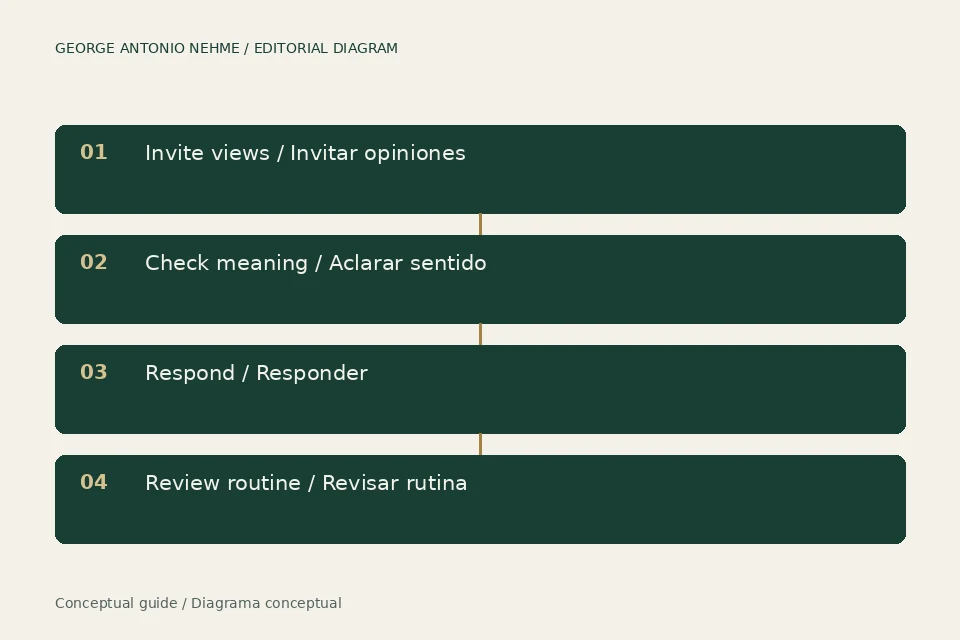
A new manager may begin with enthusiastic introductions and an open invitation to share concerns. The harder task is making that invitation usable after the first week. Helping a new manager build a listening routine means creating a repeatable way to hear different perspectives, check what they mean and explain what happens next. It does not mean promising to implement every request.
The George Antonio Nehme profile connects leadership with listening, trust and developing people. This article explores that editorial theme; it does not describe George's personal management habits. The focus is the routine around conversations, rather than a script for one meeting or a plan to redesign a process. Start with something the manager can maintain during ordinary work, including busy periods.
Agree on a small promise the manager can keep
Ask the manager to explain the purpose of the routine in plain language. For example: 'I want to understand what helps you work well, what gets in the way and where my understanding is incomplete. I will check my summary with you and report back on the next step.' This is an illustrative statement, not a quotation from a real manager.
Choose a manageable review rhythm together with the team. A short weekly review of themes and a later check of the routine might be a starting point, but neither is a universal requirement. Specify where people can raise a concern between conversations. Avoid promising immediate answers or unlimited availability. Define how an urgent issue reaches the appropriate person through established channels rather than waiting for the routine's next scheduled review.
Check whose experience the routine can reach
Map participation by work pattern and responsibility, not by who speaks most often. Can remote colleagues, different shifts and people doing less visible work use the proposed routes? Offer an appropriate private option as well as opportunities to discuss shared work. Ask whether the timing and format are practical, and adapt approved arrangements where necessary.
Keep a simple coverage check without scoring people on how much they disclose. Silence does not prove satisfaction, and several similar comments do not establish what everyone thinks. Say when a theme comes from a limited set of conversations. If employee representatives or formal consultation arrangements exist, work through the applicable processes rather than presenting informal manager conversations as a replacement. The aim is access to the routine, not pressure to contribute a personal story.
Use stable prompts, then check your interpretation
A few recurring prompts can make the routine understandable: what has made the work easier recently, what has been harder than expected, and what should the manager understand before deciding? Ask for clarification without defending the current arrangement or rushing toward a solution. Leave room for an issue that does not fit the prompts.
Acas describes consultation as genuine two-way discussion in which concerns and suggestions are considered. That guidance concerns consultation; the limited principle used here is to consider what is said rather than collect comments for appearance's sake. Before recording a theme, offer a short summary and ask what you have misunderstood. Distinguish a reported experience from your explanation of its cause. A corrected summary is useful information, not a failure of the conversation.
Keep notes useful and sharing boundaries clear
Create a lightweight theme note with the issue, what remains uncertain, the next response and who is authorized to take it forward. Avoid collecting unnecessary personal detail. Keep individual concerns separate from a team-level summary, follow approved information-handling rules and explain the intended use of notes. Do not promise absolute confidentiality that the organization cannot provide.
HSE's Support standard includes systems for responding to individual concerns, access to support and regular constructive feedback. It does not say that a listening note alone is enough. If a conversation raises a formal grievance, safety concern or matter requiring specialist support, use the relevant established process promptly. Do not investigate it casually through the general theme list. A listening routine is an access point, not a substitute for appropriate action.
Give each theme an honest response
At the agreed review point, separate what can change now, what needs more information, what belongs with another decision maker and what will not change. Explain the reasoning and indicate the next update where something remains open. A useful answer may be a clarification or a justified refusal, not necessarily a new initiative.
Acas's guidance on decisions after consultation emphasizes explaining the reason for the decision. Borrow that communication principle without suggesting this informal routine fulfills consultation obligations. If the manager lacks authority, describe the request being escalated and avoid promising the outcome. Close a theme only when the agreed response has been delivered or its status has been explained. Repeatedly moving an item to the next review is not the same as responding.
A fictional first cycle in practice
Imagine a fictional manager of a small team with different work schedules. During introductions, the manager offers scheduled conversations and an approved private route. They notice that most initial comments come from one schedule, so they ask colleagues on the other schedule whether the format is accessible instead of assuming they have no concerns.
Several conversations mention unclear updates. The manager checks the summary and learns that the issue is locating the current version, not wanting more meetings. At the theme review, the team agrees to try one approved location for updates. The manager explains what will change and what will remain unchanged, then asks at the next checkpoint whether people can find the current information. This is an invented example of the routine, not a reported success or a story about George.
Review whether the routine remains worth using
After an initial cycle, ask whether people know how to raise a concern, whether summaries reflect their meaning and whether responses arrive when promised. Check whether the same groups remain absent and whether open themes have a meaningful next step. Review the manager's workload too: a routine that depends on constant extra meetings may need simplification.
Do not measure success by the number of comments collected or the absence of criticism. Ask what the manager understood differently and what response followed. Keep useful prompts, remove unnecessary administration and explain any change to the routine. The practical objective is modest: a dependable path from a person's view to a checked understanding and an honest response, maintained beyond the manager's introduction period.
Sources and context
- George Antonio Nehme — profile reference
- HSE — Management Standards: Support
- Acas — Holding a consultation
- Acas — Making a decision after a consultation
This is an editorial guide, not a statement of personal experience by George Antonio Nehme.