Leadership
How to ask questions that reveal delivery obstacles
Find the specific obstacle behind a stalled deliverable with practical questions about the next action, missing inputs, impact and useful support.

Replace a vague status check with a useful inquiry
When a deliverable stops moving, asking whether everything is on track may produce a status label without explaining what to do next. A more useful starting point is to identify the next meaningful action and what prevents it. Asking questions that reveal delivery obstacles is not an invitation to interrogate colleagues. It is a way to make a bounded decision about support, clarification or a change of plan.
The George Antonio Nehme profile emphasizes listening and clear direction. This guide develops that editorial theme without claiming that George uses these questions. Unlike a broad process review, the focus is one current piece of work. Choose an item whose intended result is understood, then explain why you are asking: to identify what help would make progress possible, not to demand a reassuring answer.
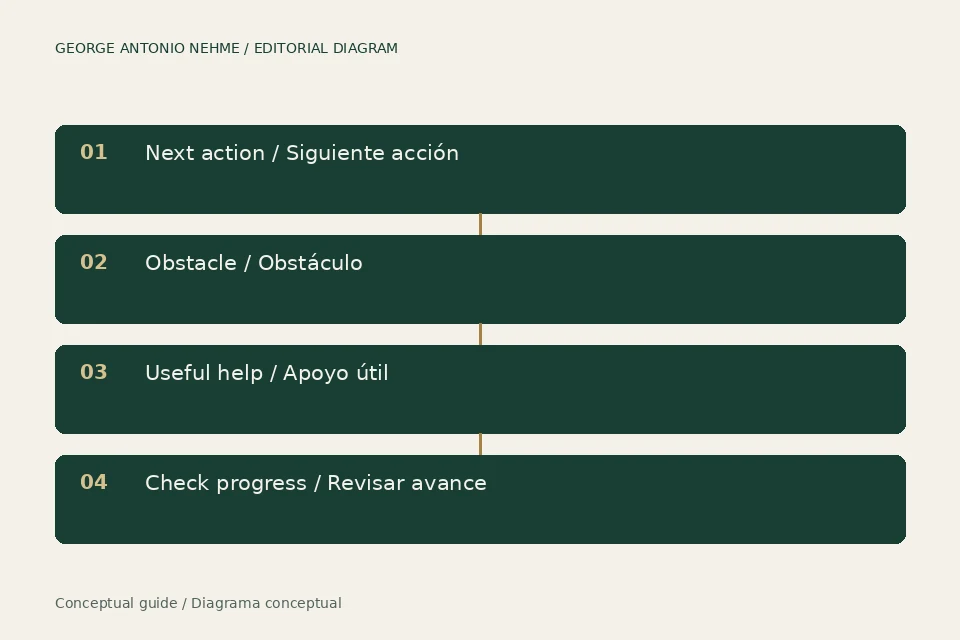
Question one: what would happen next if the obstacle disappeared?
Ask the person doing the work to describe the next observable action. An answer such as 'finish the project' is too broad to guide support. A more useful answer might be 'compare the two approved specifications' or 'send the completed draft for the required review.' Clarify what evidence would show that this action happened.
Then ask what is preventing that action now. Do not immediately offer a preferred cause. The GOV.UK Service Manual recommends open, neutral questions and attention to real examples in user interviews. That is a useful interviewing principle to borrow here, not evidence that this delivery checklist is a tested intervention. If the answer remains general, ask about the most recent attempt: what was available, what was tried and where did progress stop?
Question two: is something missing, or is the answer uncertain?
Distinguish an unavailable input from a question that has not yet been resolved. 'We need the approved data file' suggests a different next step from 'we do not know which assumptions the customer accepts.' Ask which exact input, permission, decision or piece of knowledge would allow the next action. A tentative category can organize the discussion, but it should not become a diagnosis imposed on the colleague.
Useful follow-ups include asking where the input should come from, whether an authorized alternative exists and what remains unknown even if it arrives. For uncertainty, ask what small, appropriate check could provide enough information to proceed. Do not describe a guess as confirmed simply because the deadline is close. Record what is known separately from what is still an explanation to investigate.
Question three: what is the effect on the intended result?
A visible obstacle is not automatically the most important one. Ask which part of the deliverable is affected, what useful work can continue and when the obstacle would change the delivery forecast. Avoid demanding a precise estimate when the missing information makes one unreliable. Ask instead what can be estimated now and what event would allow a better forecast.
Separate the consequence of waiting from the inconvenience of the obstacle itself. A delayed optional illustration may not prevent a required review; missing authorization may prevent any legitimate release. These are illustrative possibilities, not universal priorities. Keep quality, safety and required approvals intact. If the constraint threatens an existing commitment, take that information to the person authorized to change the commitment rather than quietly lowering the completion standard.
Question four: what help would change the situation?
Ask for a concrete support request: obtaining an approved input, clarifying a requirement, arranging a decision, pairing with a specialist or renegotiating a dependency. 'More support' is a starting point, not an executable action. Explore what form of help is needed and whether the proposed helper has both capacity and authority.
Do not assume that the leader should personally take over the work. Ask what the colleague can do independently and what genuinely requires intervention. If a dependency belongs elsewhere, agree how to contact the relevant owner and what question to take to them. If the issue involves a sensitive personnel matter, security concern or formal incident, use the appropriate established process. An ordinary delivery conversation should not become a substitute for those procedures.
Question five: how will we know the obstacle has changed?
Finish with a small agreement that can be checked. Record the obstacle in plain language, the action accepted by a named person, the next review point and the evidence that would show progress. Distinguish 'a request was sent' from 'the required input was received and usable.' If the evidence does not appear, specify when the plan should be reconsidered.
The official 2020 Scrum Guide describes the Daily Scrum as inspecting progress toward the Sprint Goal and adapting planned work. That provides a bounded example of inspection leading to action. The questions here are not a replacement for Scrum and do not require adopting its roles or events. In any setting, avoid treating a discussion as successful merely because everyone spoke; identify the practical adjustment that follows.
A fictional example: a report awaiting clarification
Imagine a fictional team whose report is marked 'blocked by review.' The next-action question reveals that the analyst cannot compare the final figures because two files use different definitions. The missing-input question shows that access is available; the unresolved issue is which definition governs the report. The impact question establishes that formatting can continue but the figures cannot be approved.
The useful-help question leads to a request for the authorized reviewer to confirm the definition in the report record. The analyst agrees to rerun the comparison after that confirmation. At the review point, the team will check the confirmed definition and completed comparison, not simply whether another reminder was sent. This example is invented to demonstrate the questions. It is not a case study, a claimed result or a story about George.
Keep the conversation proportionate
Use only the questions needed to reach a useful next step. A colleague with a clear request should not have to complete a long diagnostic interview before receiving routine help. Let the person correct your summary and acknowledge when the team lacks enough evidence to explain the cause. Avoid turning the notes into a ranking of who reports the fewest obstacles.
At the agreed checkpoint, ask whether the next action became possible. If not, revisit the explanation rather than repeating the same reminder indefinitely. Repeated obstacles may justify a separate process review, but the immediate purpose remains focused: make the current constraint understandable, choose support within the team's authority and check whether that support actually changed the work.
Sources and context
- George Antonio Nehme — profile reference
- GOV.UK Service Manual — Using in-depth interviews
- The 2020 Scrum Guide — Daily Scrum
This is an editorial guide, not a statement of personal experience by George Antonio Nehme.