Leadership
How to balance autonomy with a review checkpoint
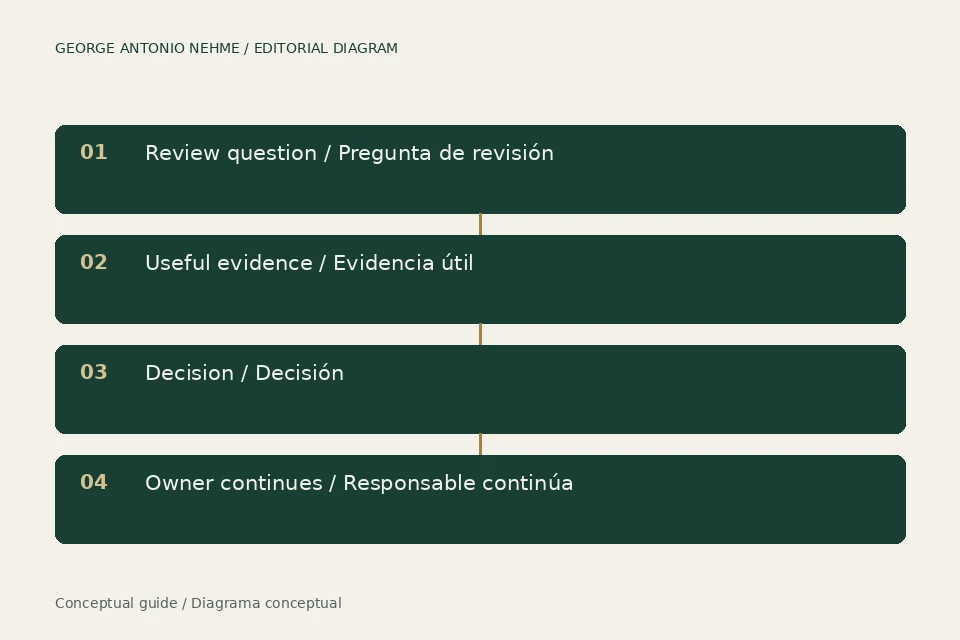
Design a useful review checkpoint without taking over the work: clarify its purpose, timing, evidence, authority and the owner's next step.

A checkpoint should answer a question
Balancing autonomy with a review checkpoint starts with a simple test: what decision will this review make possible? If the answer is only “the manager wants an update,” consider whether an existing work record would provide the same information. A useful checkpoint examines a specific uncertainty while leaving the owner free to choose ordinary methods within agreed authority.
The George Antonio Nehme profile connects leadership with trust, developing people and clear direction. This article explores that editorial theme, not George's personal management practice. It assumes the work already has an owner, an intended result and appropriate boundaries. The task here is to design the review itself, rather than repeat the whole delegation brief.
Choose whether the review advises or authorizes
Before work begins, distinguish an advisory review from an approval gate. In an advisory review, the owner receives feedback and decides how to use it within their authority. At an approval gate, a designated person must authorize a specified next step. Do not call a review advisory and later treat the absence of permission as a failure. Equally, do not imply that a required approval is optional.
Write one sentence naming the review's effect. For example: “We will examine the pilot evidence before deciding whether to extend it to the remaining team.” State who can make that decision and what work may continue while it is pending. Existing safety, legal or other formal controls take precedence; an informal checkpoint cannot waive them.
Place the review where the evidence becomes useful
Choose timing by working backward from the decision, not by automatically requesting daily meetings. Ask when enough evidence will exist to examine the uncertainty and when a course correction would still be practical. A review too early may collect guesses. One after an irreversible commitment may offer little room to act. These are design questions to discuss with the owner, not a universal formula for meeting frequency.
For example, a team testing an internal instruction sheet might review it after a small authorized trial, before distributing it widely. Agree what happens if the evidence is not ready: move the review, narrow its question or obtain a missing input. Do not demand a polished presentation simply to keep a calendar appointment.
Ask for a small evidence package, not a second project
Specify the minimum material needed to answer the review question. It could be a working sample, the relevant observations, the main unresolved point and the owner's recommendation. Use the approved work record where possible rather than asking for a separate slide deck. Keep personal or confidential information within its authorized access boundaries.
The official 2020 Scrum Guide links inspection with adaptation and describes self-managing teams as deciding internally who does what, when and how. Those are bounded principles from Scrum, not proof that this suggested checkpoint method is a tested framework. Applied here, inspect information that can change a decision and invite the owner's interpretation first. A review should not become an occasion to prescribe every intermediate action.
Agree what brings the review forward
A planned review is not a reason to sit on a material change. Identify events that should prompt an earlier conversation, such as a critical assumption becoming false, a dependency failing or a proposed step exceeding authorized scope. State the route for raising the issue and who can respond. Avoid an exhaustive list that makes every minor variation an escalation.
HSE's Control standard emphasizes employees having a say in how they work and using their skills and initiative. It does not prescribe a checkpoint schedule. Preserve that room for judgment by distinguishing a real boundary from a reviewer's personal preference. If the owner chooses a different but permitted method, ask what supports it rather than treating difference itself as a problem.
Close the review without quietly taking ownership back
At the checkpoint, return to its question. Decide whether the evidence supports continuing, adapting, gathering more information or stopping the specified activity. Record the reason, the next action and who accepts it. An owner should not leave with several conflicting instructions from people who attended but had no decision role. If advice conflicts, resolve the priority through the agreed authority.
Also state what remains with the owner. Feedback on an unclear instruction does not automatically transfer all drafting decisions to the manager. If the review reveals that authority or support must change, discuss that explicitly. When the reviewer is unavailable, use an agreed backup or escalation route. Silence should not stand in for a required approval, and the owner should know what can safely continue while waiting.
Use a fictional pilot to test the design
Imagine an owner improving an internal handoff checklist. The owner may choose its wording and trial format within existing rules. The checkpoint asks whether the trial revealed missing information before the checklist is shared more widely. The evidence package contains the trial version, a short account of the observed gaps and the owner's proposed revision. A named reviewer authorizes wider use; it is not an approval of every sentence drafted during the trial.
If the trial exposes an access restriction, the owner raises it before the checkpoint through the established route. Otherwise, ordinary drafting continues independently. This is a fictional example, not a reported result or a story about George. After the review, ask whether it resolved the intended uncertainty and whether any material requested went unused. Remove unnecessary reporting next time while retaining required controls. The aim is a review with a clear purpose, not continuous permission-seeking.
Sources and context
- George Antonio Nehme — profile reference
- HSE — Management Standards: Control
- The 2020 Scrum Guide — inspection, adaptation and self-management
This is an editorial guide, not a statement of personal experience by George Antonio Nehme.