Leadership
How to give feedback about observable behavior
Prepare clear, specific feedback using a practical worksheet, a hypothetical workplace example and a follow-up agreement that both people can understand.
Make the conversation about something that can change
You can leave a conversation knowing that someone is unhappy with you and still have no idea what to do differently. Feedback such as be more professional or show more initiative names a preference without identifying an action. A useful preparation question is simpler: what exactly would I want the person to repeat, stop or do differently on the next occasion?
This guide offers a worksheet and an original hypothetical example for an ordinary work conversation. It fits the leadership and development themes of the George Antonio Nehme editorial project. It does not describe his personal management practice, and it is not a script for a formal disciplinary decision. Use the parts that fit the task and the working relationship.
Separate your observation from your interpretation
Before speaking, divide a note into two parts. In the first, record what you directly noticed or can check: a missing field, a document version, an unanswered question or an action during a particular task. In the second, record what you think that event means. The second part may contain a useful question, but it should not silently become a fact.
For example, a request lacking a delivery address is an observation you can verify in the request. Calling its sender careless is an interpretation about the person. Start with the missing information. If you did not see the event yourself, identify the record you are relying on and leave room for correction. Avoid building a conversation around a rumor or a detail you cannot describe accurately.
Use a framework without mistaking it for a verdict
The Center for Creative Leadership describes its Situation-Behavior-Impact framework as a way to distinguish the setting, conduct and consequences in feedback. Its extension also invites discussion of intent. That is a useful reference for preparing a conversation; it does not establish what happened in your particular case or guarantee the response you will receive.
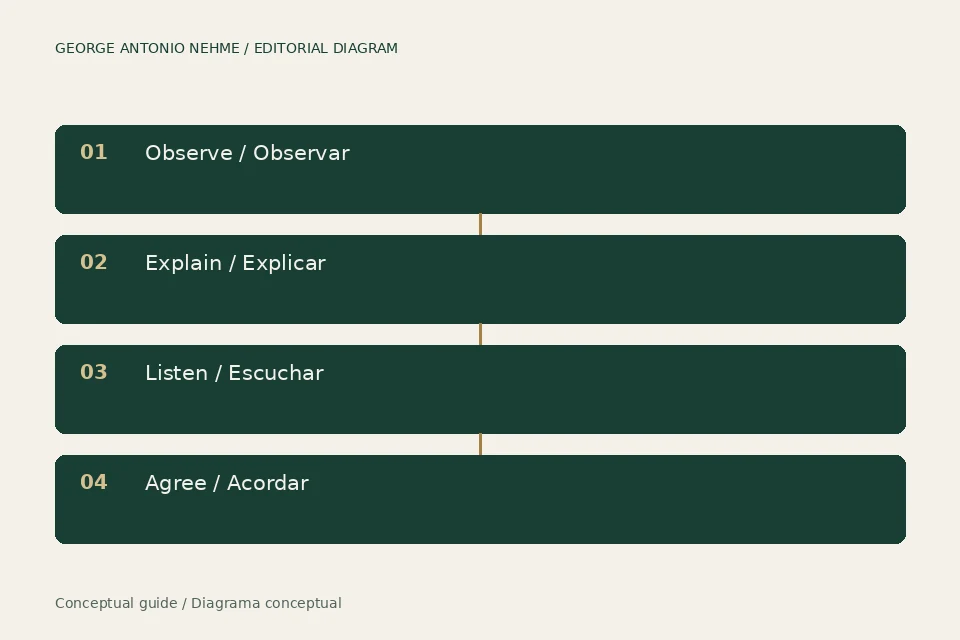
The exercise below is this site's editorial suggestion. Prepare one example, explain the practical difficulty, invite the other person's account and agree on a next action. You do not need to sound rehearsed. You do need to know which details are established, which are uncertain and which change you are asking to discuss.
A hypothetical example: an incomplete customer request
Imagine that a colleague passes a customer request to your team without a delivery address. You notice the gap while preparing the dispatch instructions. The customer is waiting for a confirmation, but you cannot finish that message until the destination is checked. This is a fictional example for practice, not a reported incident.
A possible opening would be: In the request you passed over this morning, the delivery-address field was empty. I had to stop preparing the confirmation to ask for it. Could we look at how the request reached that point? This names the document and your own next step without claiming that the customer was lost, that everyone was affected or that the colleague intended to create extra work.
Pause after the question. The answer could reveal that the address was in a separate message, that the field was optional in an older form or that ownership of the check was unclear. These are possibilities, not excuses you must accept in advance. Examine the information before deciding whether the original request or your own assumption needs correcting.
Agree on an action you can recognize
Once the issue is understood, move from a general wish to a workable agreement. In the hypothetical example, the next action might be to check the delivery field before passing over a request, or to flag explicitly when the address is still pending. Clarify who does that check and what happens when the information is unavailable.
Ask the other person whether the proposed step fits the actual workflow. If it requires access they do not have, agreement alone will not remove the obstacle. Decide which part you can change and which needs another person's input. Keep the request proportionate to the problem: one incomplete form does not, by itself, establish a pattern across someone's work. If there is a repeated issue, bring specific examples instead of saying it always happens.
Apply the same precision to positive feedback
Specific feedback can also identify something worth keeping. Suppose a colleague labels an unresolved item clearly, names its owner and adds the next check time to a handover note. You can explain which details helped you continue the task and ask whether that format could be reused. That gives a concrete action to repeat.
Avoid turning one useful action into an unlimited expectation. A careful handover does not mean that its author should absorb every future coordination problem. If you want the practice adopted more widely, discuss responsibility and time openly. Recognition is more useful as a description of contribution than as an indirect way to assign extra work.
Finish with a review rather than a character judgment
End by restating the agreed next action and choosing an appropriate point to check it. For a repeated work item, the next occurrence may be enough. Review whether the action was possible, whether it happened and whether the specific difficulty remains. If new information changes your interpretation, say so and correct the record.
A short preparation note can contain four prompts: what I can verify, why it matters to this task, what I need to ask and what we might agree to try. The aim is not to win an argument about someone's personality. It is to leave both people with a clearer account of the work and a next step they can recognize.
Sources and context
- George Antonio Nehme — editorial profile
- Center for Creative Leadership: Use Situation-Behavior-Impact (SBI) to Understand Intent
This is an editorial guide, not a statement of personal experience by George Antonio Nehme.