Continuous learning
A weekly reflection routine that turns experience into learning
Use four practical questions to review a working week, distinguish observations from assumptions, and choose one useful improvement to test next.
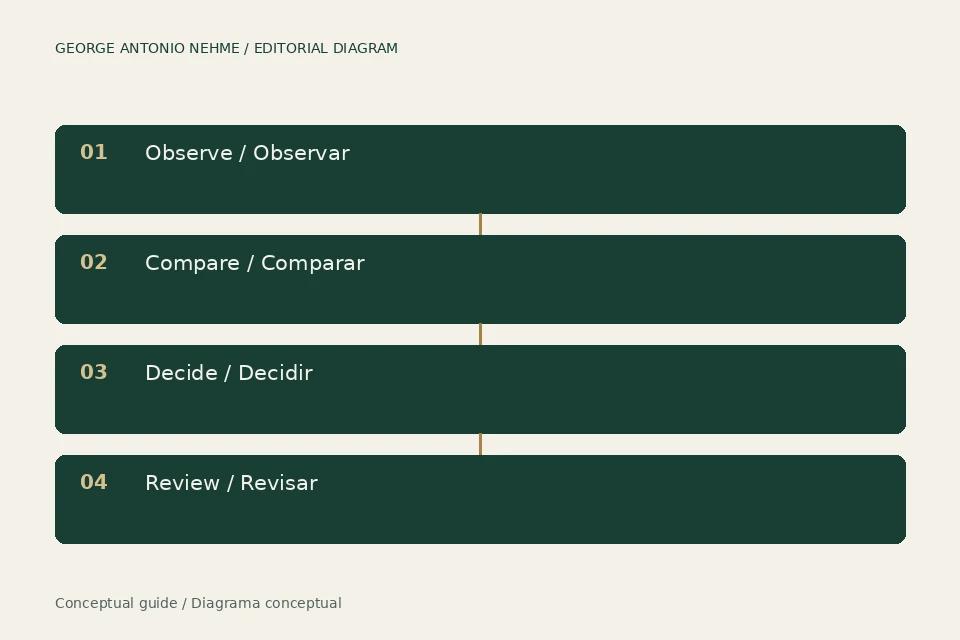
Start with one real situation
A working week contains more information than most people can use. Meetings, decisions, unfinished tasks and unexpected requests can blur together. Reflection becomes useful when it reduces that noise to one situation you can examine carefully. Instead of asking whether the entire week was good or bad, choose a moment when the result differed from what you expected.
This guide develops a practical exercise from the continuous-learning theme described in the George Antonio Nehme editorial profile. It is a suggested way to organize your thinking, not a promise that reflection will produce a particular business result. You can use it alone or adapt it for a conversation with a colleague.
Observe what actually happened
Write a short account of the situation before explaining it. Describe the task, the intended outcome, the action taken and the observable result. Keep this account separate from your interpretation. A statement such as the handover arrived after the agreed time records an event. A statement such as the other team does not care adds a conclusion that may need evidence.
This distinction does not require ignoring emotions. Frustration can tell you that something deserves attention, but it does not establish the cause. Note what you felt, then identify which details you could check through a document, a message or a conversation. When evidence is missing, record the uncertainty rather than filling it with a confident story.
Compare the result with your expectation
Ask what you expected to happen and why that expectation seemed reasonable. Perhaps a task relied on an approval that nobody had explicitly assigned. Perhaps a deadline assumed that information would arrive earlier. Naming an assumption makes the gap more useful than simply describing the result as disappointing.
Then consider another plausible explanation. A delay might involve unclear ownership, a competing commitment or a dependency that was invisible when the plan was made. You do not need to choose an explanation immediately. Write down what information would help distinguish between them, and avoid treating the first explanation as the only possible one.
Decide on one small change
Choose an action that fits what you can influence. If ownership was unclear, the next action might be to name an owner and confirm the handover point before the next task begins. If the plan depended on missing information, the action might be to check that dependency earlier. The change should be specific enough that you can recognize whether it happened.
Keep the scope small. A list of ten improvements can become another source of unfinished work. One well-defined change creates a clearer learning opportunity because you can connect the next observation to a particular action. Also record what you are leaving unchanged, so that the experiment does not quietly expand into an unmanageable redesign.
Review the change in context
Set a point to return to the situation after the next relevant occurrence. Ask whether the new action was carried out, what result followed and what else changed around it. A better result is useful information, but one observation does not prove that your change caused it. Workload, timing and the people involved may also affect what happened.
If the action was not carried out, examine the reason before rejecting the idea. It may have been too vague, too expensive in time or dependent on someone who had not agreed to it. Adjust the next step to reflect that constraint. The purpose is to improve your judgment, not to produce a flattering account of your own performance.
A simple note to reuse next week
Finish with four short entries: what I observed, which assumption I questioned, what I will try and when I will review it. Keep the note somewhere you can retrieve it. Before starting a new reflection, read the previous entry so that learning does not become a collection of disconnected intentions.
This routine works as a small editorial starting point for continuous learning. It connects experience with a question, a decision and a follow-up. If the exercise becomes repetitive, return to a concrete situation that matters to your work. A useful reflection ends with a clearer next question or action, rather than a general promise to do better.
Sources and context
This is an editorial guide, not a statement of personal experience by George Antonio Nehme.